
AI 期望差距
原题The AI expectations gap
推荐理由这份公众与从业者的比较调查,帮助读者区分对 AI 能力的预期和对就业影响的推理,理解乐观分歧究竟从哪里开始。
读前速览
一项针对美国成年人和 Anthropic 员工的调查发现,双方对当前 AI 能力有广泛共识,但对未来进展的期望存在明显差距:员工对能力提升、生产力和自身工作自动化的前景远为乐观,然而两个群体都将个人 AI 暴露度与更高的失业预测联系起来。
美国成年人和 Anthropic 员工对 AI 当前能做什么看法一致,但对未来进展的速度分歧明显。
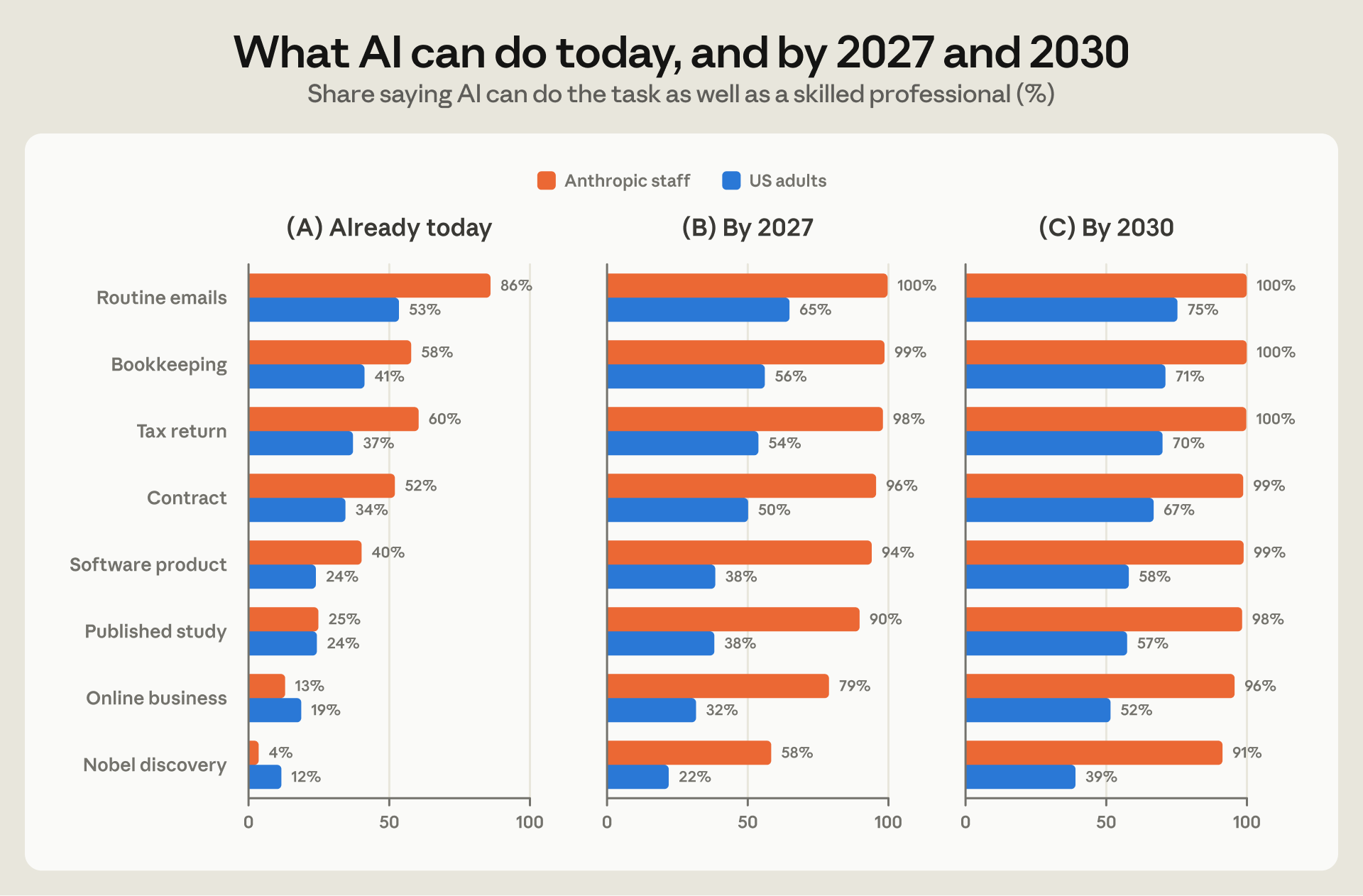
两个群体对八项任务的难度排序几乎相同,对当前能力的看法也大致一致,但到 2030 年,91% 的员工预计 AI 将做出诺贝尔奖级别的发现,而美国成年人中这一比例为 39%;多达 40% 的美国成年人表示 AI 永远无法完成某些任务,而员工中这一比例最多为 2%。
Anthropic 员工预计生产力提升和自身工作自动化程度远高于普通劳动者。
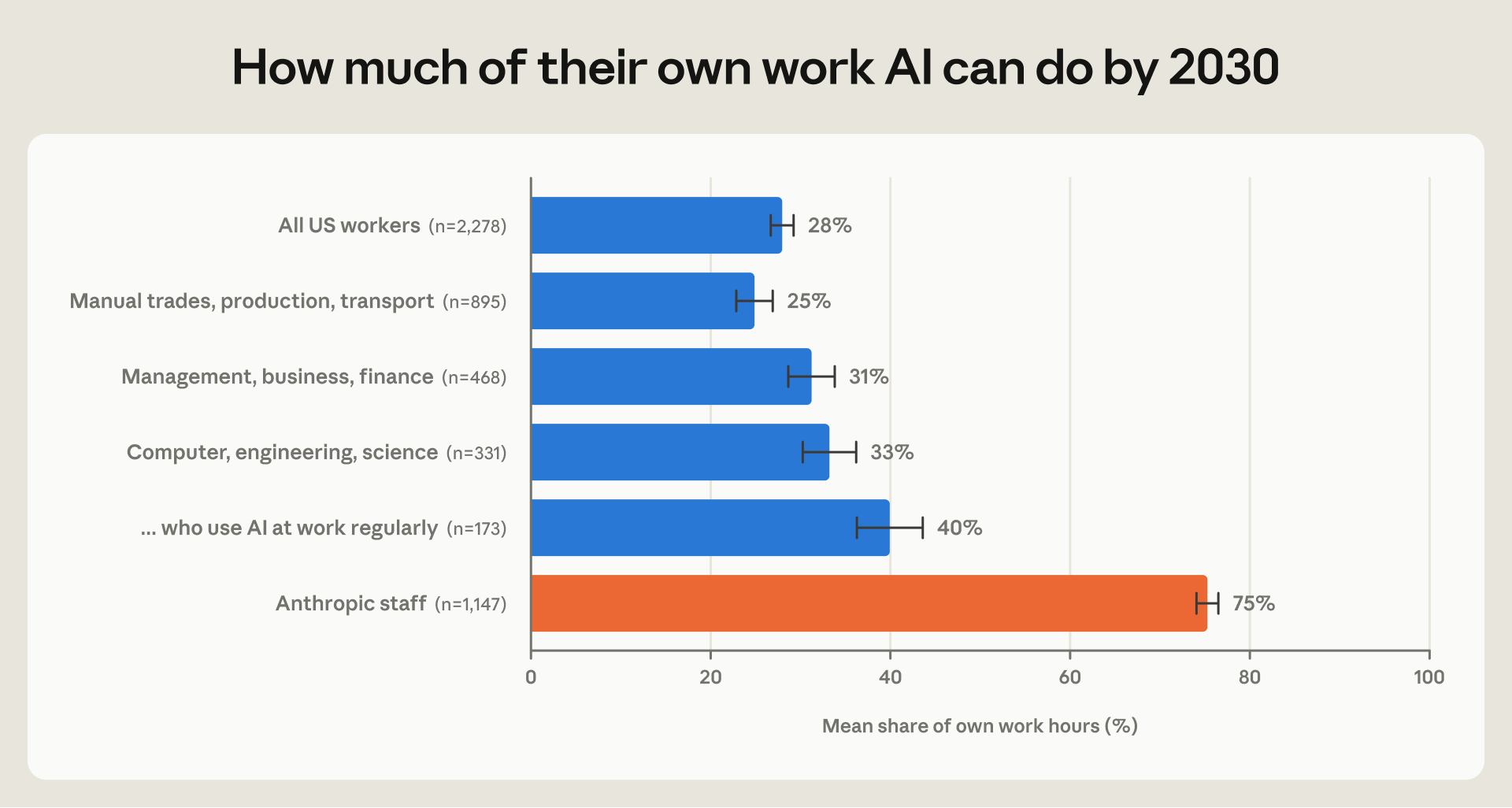
员工预计到 2030 年 AI 能完成其当前工作的 75%,而美国劳动者预计为 28%;59% 的员工表示适合 AI 的任务耗时缩短至四分之一或更少,而使用 AI 的劳动者中这一比例为 26%。员工还预计到 2030 年 AI 将用于 65% 的可行任务,而美国成年人预计为 42%。
两个群体都以相似方式将个人 AI 暴露度与更高的失业预测联系起来。
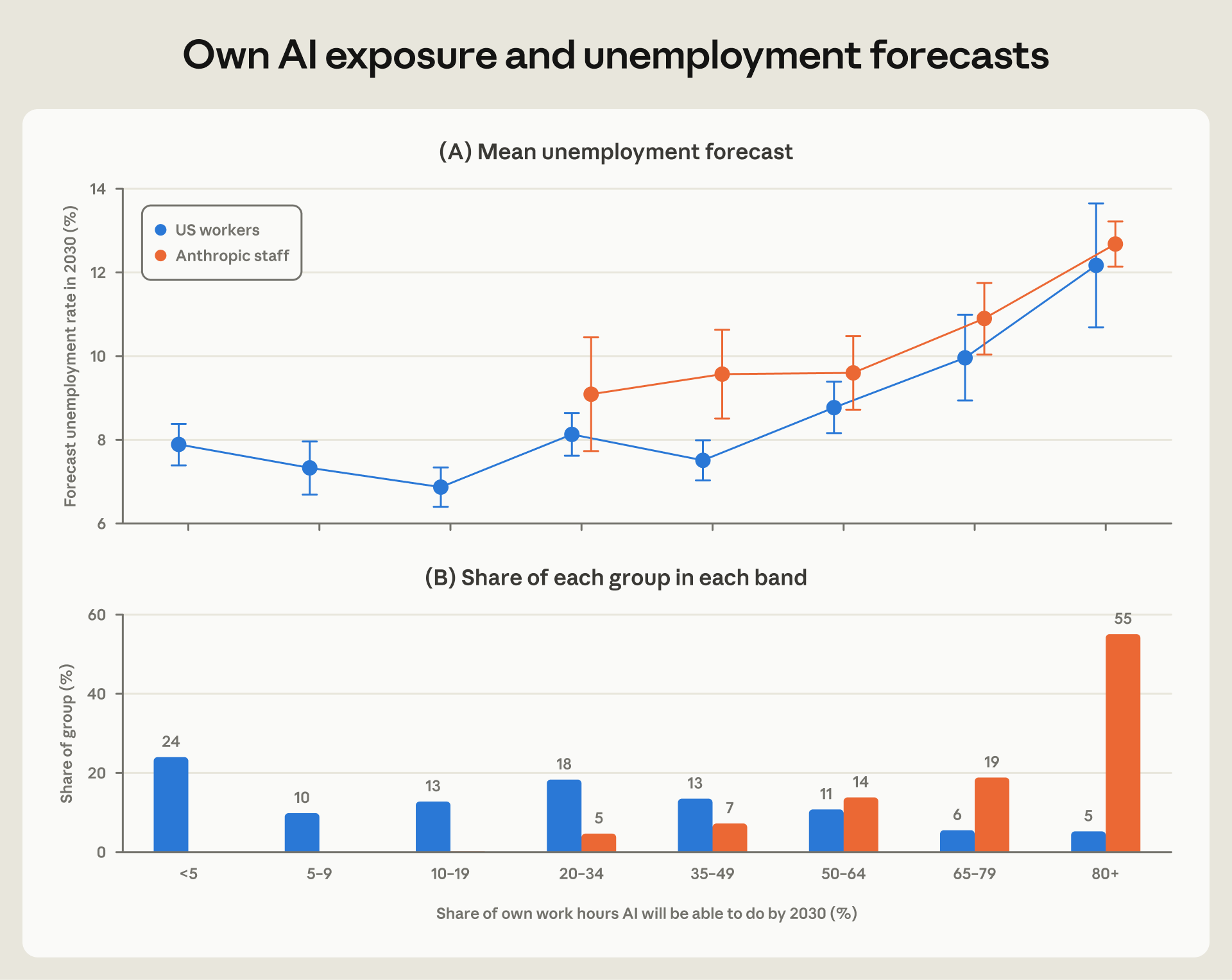
预计 AI 将完成其 80% 或更多工作的美国劳动者预测 2030 年失业率为 12.2%,高于大金融危机峰值;员工中也出现相同的梯度,表明尽管能力信念不同,他们对劳动力市场效应的推理方式一致。
在前沿实验室,自动化任务与减少员工人数是不同的预期。
95% 的 Anthropic 员工预计未来 12 个月员工人数将增长,预期增长中位数为 66%,即便他们预计 AI 将完成其大部分工作;对于被替代劳动者的再就业时间线,员工比美国成年人略为悲观。
模型隐含的 GDP 增长在不同群体间差异很大。
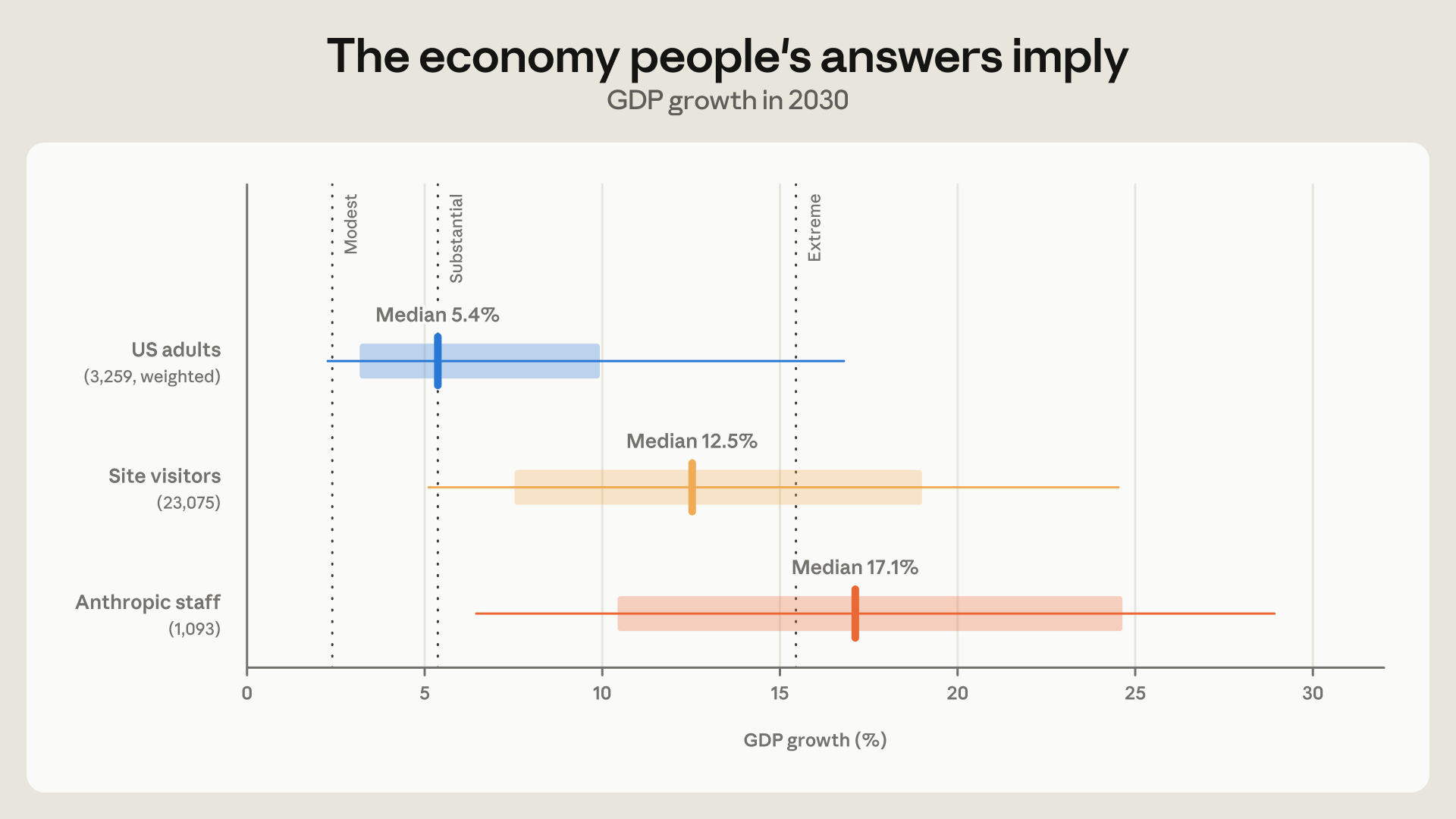
通过「变革性 AI 经济情景」模型映射回答,美国成年人中位数对应 2030 年 5.4% 的 GDP 增长,员工中位数为 17.1%,访问交互式探索器的网站访客为 12.5%,且群体内部差异很大。
完整摘要
Anthropic 研究人员于 2026 年 8 月对 10,980 名具有全国代表性的美国成年人和 Anthropic 员工进行了调查,内容涵盖 AI 能力、采用情况、自主性、节省时间和劳动力市场预期。两个群体对当前 AI 能力的排序相似,但对未来的看法分歧明显:91% 的员工预计 AI 将在 2030 年前做出诺贝尔奖级别的发现,而美国成年人中这一比例为 39%;员工预计 AI 能完成其当前工作的 75%,而美国劳动者预计为 28%。员工还报告了更大的时间节省(59% 的员工表示任务耗时缩短至四分之一或更少,而使用 AI 的劳动者中这一比例为 26%)。尽管存在这些差异,两个群体对劳动力市场的推理方式相似:那些预计 AI 会承担自己更多工作的人预测失业率更高,且两个群体呈现相同的梯度。尽管如此,员工仍预计 Anthropic 的员工人数将增长。通过经济模型映射回答,美国成年人中位数对应 2030 年 5.4% 的 GDP 增长,员工为 17.1%,而访问交互式探索器的网站访客为 12.5%。
目录 · 23 节

西蒙·萨赫尔、特丝·科特、查尔斯·I·琼斯、安东·科里内克、彼得·麦克罗里Szymon Sacher, Tess Cotter, Charles I. Jones, Anton Korinek, Peter McCrory
主要发现Key findings
- 美国成年人预计,未来几年 AI 能力将迅速提升;Anthropic 员工预计进展会更快;39% 的美国成年人和 91% 的员工认为,到 2030 年,AI 将能够取得诺贝尔奖级别的发现。US adults expect AI capabilities to advance rapidly in the coming years; Anthropic staff expect even faster progress; 39% of US adults and 91% of staff expect that AI will be able to make a Nobel-level discovery by 2030.
- Anthropic 员工预计,AI 在其擅长的任务上能带来更大的生产力提升。在使用 AI 工作的美国成年人中,26% 表示借助 AI 完成一项任务所需的时间缩短至原来的四分之一或更少;Anthropic 员工中这一比例为 59%。Anthropic staff expect much larger productivity gains from AI on the tasks it is well-suited for. Among US adults who use AI at work, 26% say a task takes a quarter of the time or less with AI, compared to 59% of Anthropic staff.
- 谈到自己的工作时,超过半数的 Anthropic 员工预计,到 2030 年,AI 将能够完成他们目前至少 80% 的工作;而美国劳动者中持这一看法的仅占 5%。When it comes to their own job, over half of Anthropic staff expect AI to be able to do at least 80% of their current work by 2030, compared with 5% of US workers.
- 在美国劳动者和 Anthropic 员工这两群人中,预计 AI 会承担自己更多工作的人,对失业率上升的预期也更高。尽管双方对 AI 未来能力的看法有所不同,但他们对 AI 可能如何改变自身工作与更广泛的失业之间关联的感知非常相似。Among both US workers and Anthropic staff, people who expect AI to do more of their own work anticipate higher unemployment. While there are differences in beliefs about future capabilities, the perceived link between how AI might change one’s own job and broader unemployment is very similar for both groups.
简介Introduction
未来几年,人工智能将如何重塑经济?人工智能的能力正在迅速提升,而未来的人工智能模型或许能够构建自己的后继模型(递归式自我改进),这可能进一步加快进步的速度。这种情况会以多快的速度出现、发展到何种程度,目前尚不明确。各种预测差异很大,相关争论也十分激烈。How will AI reshape the economy in the years ahead? AI capabilities are advancing rapidly, and the possibility that future AI models may be able to build their own successors (recursive self-improvement) could further accelerate the rate of progress. How quickly this might materialize and to what extent is unclear. Forecasts vary widely and are fiercely debated.
关于人工智能未来对经济的影响,分歧的核心来源是什么?这主要是由于人们对人工智能能力提升速度的看法不同吗?还是说,分歧反映了人们对这些能力转化为现实应用的速度和形式存在不同意见?哪些关于人工智能未来发展路径的观点与快速经济增长相一致?What is the core source of disagreement about AI's future impact on the economy? Is it principally due to differences in beliefs about how quickly AI capabilities will improve? Or does it reflect disagreement about how quickly and in what form those capabilities translate to real-world adoption? Which views on the future path of AI are consistent with rapid economic growth?
本说明介绍了针对这些问题的新调查证据。2026 年 8 月,我们调查了两个群体:一组具有全国代表性的美国成年人样本,以及 Anthropic 员工。¹ 调查问题涉及多个方面,包括 AI 的能力、其应用范围、能够节省多少时间、其自主程度,以及失业劳动者转行求职的难度。² Anthropic 员工每天都在开发和使用前沿 AI。因此,第二项调查反映了最接近这项技术的人如何预期其未来发展,包括其能力和更广泛的经济影响。This note presents new survey evidence on these questions. In August 2026, we surveyed two groups: a sample of US adults that was nationally representative and Anthropic staff.1 The questions covered, among other things, AI’s capabilities, how widely it will be used, how much time it saves, how autonomous it will be, and how difficult it will be for a displaced worker to find a job in a different occupation.2 Anthropic staff build and use frontier AI every day. The second survey therefore shows how people closest to the technology anticipate its future, both in capabilities and in broader economic impact.
我们报告以下主要发现。首先,两组人对 AI 目前能做什么大体看法一致,但对未来进步的速度意见不同。Anthropic 员工预计,AI 能力将提升得更快、应用将更加广泛且较少需要人工参与,并且 AI 在一项任务上节省的时间将大幅增加。例如,91% 的员工预计,到 2030 年,AI 能够取得诺贝尔奖级别的发现;相比之下,美国成年人中这一比例为 39%。We report the following main findings. First, the two groups largely agree about what AI can do today but disagree about the pace of future progress. Anthropic staff expect capabilities to advance faster, AI to be used more widely and with less human involvement, and the time it saves on a task to be much larger. For example, 91% of staff expect AI to be able to make a Nobel-level discovery by 2030, compared to 39% of US adults.
其次,人们对自己的工作岗位存在显著分歧。平均而言,员工预计到 2030 年,人工智能能够完成他们目前 75% 的工作;而美国劳动者整体的预期比例为 28%。Second, there are sharp differences concerning people's own jobs. On average, staff members expect AI to be able to do 75% of their current work by 2030, compared to 28% for US workers overall.
第三,两组人似乎以相似的方式看待劳动力市场:预期未来人工智能将承担更多自身工作的人,预测的失业率更高。而在对自身工作被人工智能自动化的预期程度相同的情况下,两组人预测的失业率也大致相同。Third, the two groups seem to reason about the labor market in a similar way: people who expect AI to do more of their own work in the future forecast higher unemployment. And, at the same level of expected AI automation of their own work, both groups forecast about the same unemployment rate.
人们期待 AI 做什么What people expect AI to do
功能性能力Capabilities
我们首先考察人们对 AI 能力的预期。我们询问 AI 何时能像熟练的专业人士一样完成八项任务,范围从撰写日常邮件到取得诺贝尔奖级别的科学发现。美国成年人和 Anthropic 员工对 AI 目前能做到什么基本持一致看法,尤其是在较复杂的任务上。两组人对各项任务难度的排序几乎完全相同(图 1,A 面板)。We first investigate expectations about AI capabilities. We asked when AI will be able to do each of eight tasks as well as a skilled professional, from writing routine emails to making a Nobel-level scientific discovery. US adults and Anthropic staff largely agree on what AI can do today, particularly when it comes to more complex tasks. Both groups rank tasks in nearly the same order of difficulty (Figure 1, panel A).
这些群体对 AI 未来发展的路径看法不一。例如,约四分之一的美国成年人和 Anthropic 员工认为,AI 如今已经能够设计、开展并发表科学研究。但到明年,十分之九的员工预计 AI 将具备这种能力,而普通公众中持此看法的仅占 38%。到 2030 年,39% 的美国成年人预计 AI 能够取得诺贝尔奖级别的发现(图 C),员工中的这一比例则为 91%。或许最显著的差异在于,视任务而定,19% 至 40% 的美国成年人认为 AI 永远无法完成某项任务,而员工中持此看法的最多只有 2%。The groups disagree on the path of future AI progress. For example, around a quarter of US adults and Anthropic staff think that AI can design, conduct, and publish scientific studies today. But by next year, 9 in 10 staff expect this to be feasible for AI as compared to just 38% for the general public. By 2030, 39% of US adults expect AI to be able to make a Nobel-level discovery (panel C), compared with 91% of staff. What is perhaps the most striking difference, depending on the task, between 19 and 40% of US adults say AI will never be able to do a given task, compared with at most 2% of staff.
观点上的差异,部分反映了人工智能使用频率的不同。在经常在工作中使用人工智能的人群中(约占受访者的五分之一),56%的人预计到2030年,人工智能能够完成所列八项任务中的至少七项。这一比例远高于所有美国成年人(41%)和从未使用过人工智能工具的人群(28%),但仍远低于员工的看法(96%)。In part, differences in views reflect differences in frequency of AI use. Among those who use AI at work regularly (about a fifth of respondents), 56% expect AI to be able to do at least seven of the eight named tasks by 2030. This is substantially higher than among all US adults (41%) and among those who have never used an AI tool (28%), but still well short of the staff view (96%).
采用及其障碍Adoption and its obstacles
人工智能对经济的影响并非仅由其原始能力决定。人和企业需要真正使用人工智能,而这需要时间和尝试。在人工智能能够完成的工作任务中,美国成年人预计,到 2030 年将有 42% 由人工智能完成。Anthropic 员工预计,未来几年人工智能的普及速度会明显更快,所有适用人工智能的任务中,将有 65% 使用人工智能。The impact of AI on the economy is not solely determined by raw capabilities. People and businesses need to actually use AI, which takes time and experimentation. Of the work tasks AI will be able to do, US adults expect that 42% will be done with AI by 2030. Anthropic staff expect noticeably faster diffusion over the next few years, with AI used for 65% of all tasks for which it could be used.
为了了解哪些因素可能阻碍 AI 在工作场所的应用,我们请美国成年人从九项因素中最多选出三项,指出他们认为影响最大的障碍。公众普遍认为,相较于技术限制,人们的偏好和相关规则可能更会阻碍 AI 的应用(图 2)。最常被选为障碍的是“客户更愿意与真人打交道”,其次是“数据隐私和安全方面的担忧”“AI 还不够可靠”以及“法律、法规或责任问题”。To understand what might hold back AI adoption at work, we asked US adults to choose up to three obstacles from a list of nine that they expect to be the biggest. The general public expects that people's preferences and rules, more than the technological constraints, may be what holds adoption back (Figure 2). “Customers preferring to deal with a person” was the obstacle selected most often, followed by “data privacy and security concerns,” “AI not being reliable enough,” and “laws, regulations or liability.”
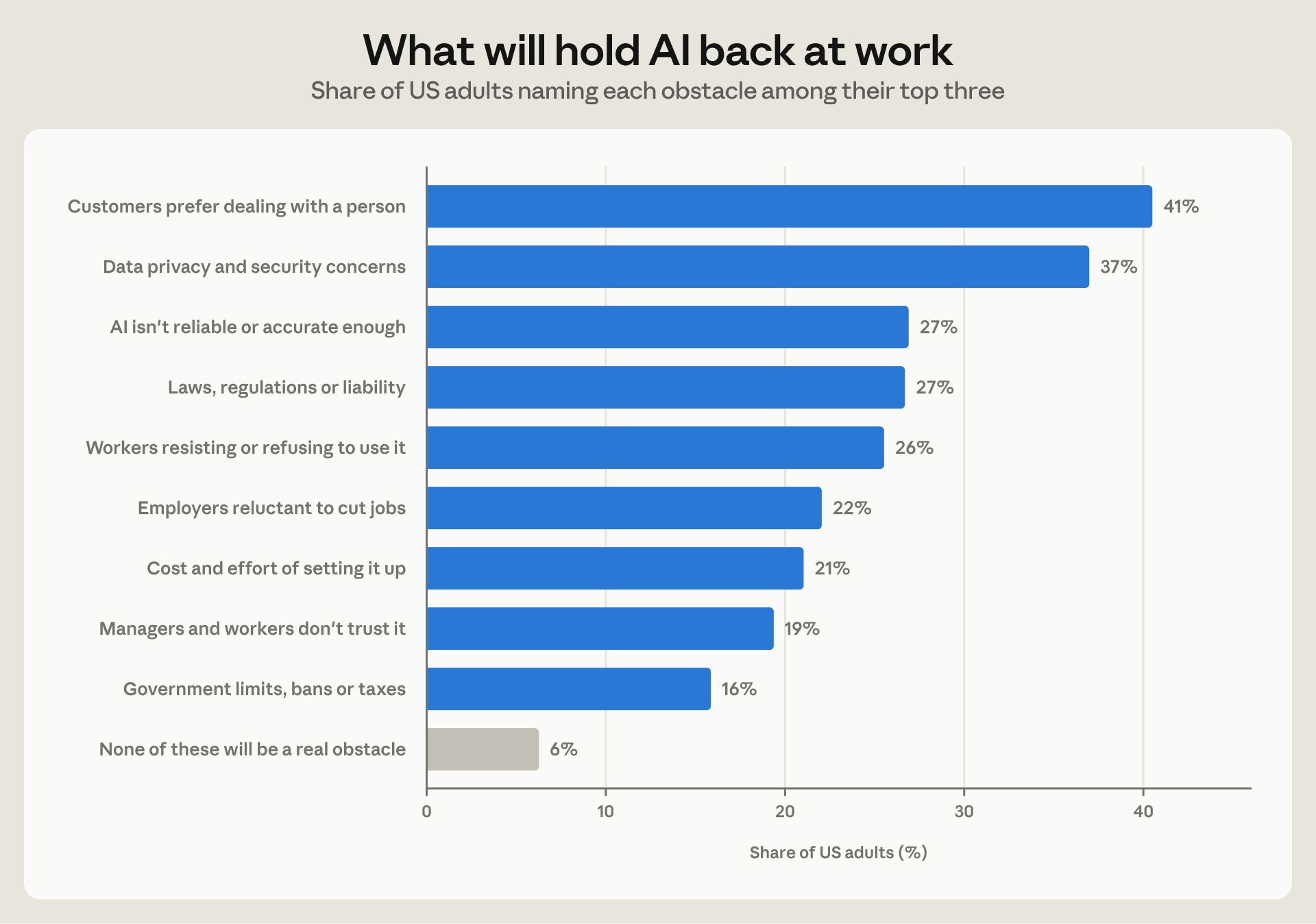
值得注意的是,经常在工作中使用 AI 的美国成年人将数据隐私和安全问题列为首要障碍(42% 将其视为三大障碍之一,而其他人中的这一比例为 37%),并认为客户偏好与真人打交道的重要性稍低(37%,而其他人中为 42%)。
Notably, US adults who use AI regularly at work rank data privacy and security concerns first (42% consider it among the top 3 obstacles, compared with 37% among the rest) and see customer preferences to deal with humans as slightly less important (37% vs 42%).
自主人工智能将达到何种程度How autonomous AI will be
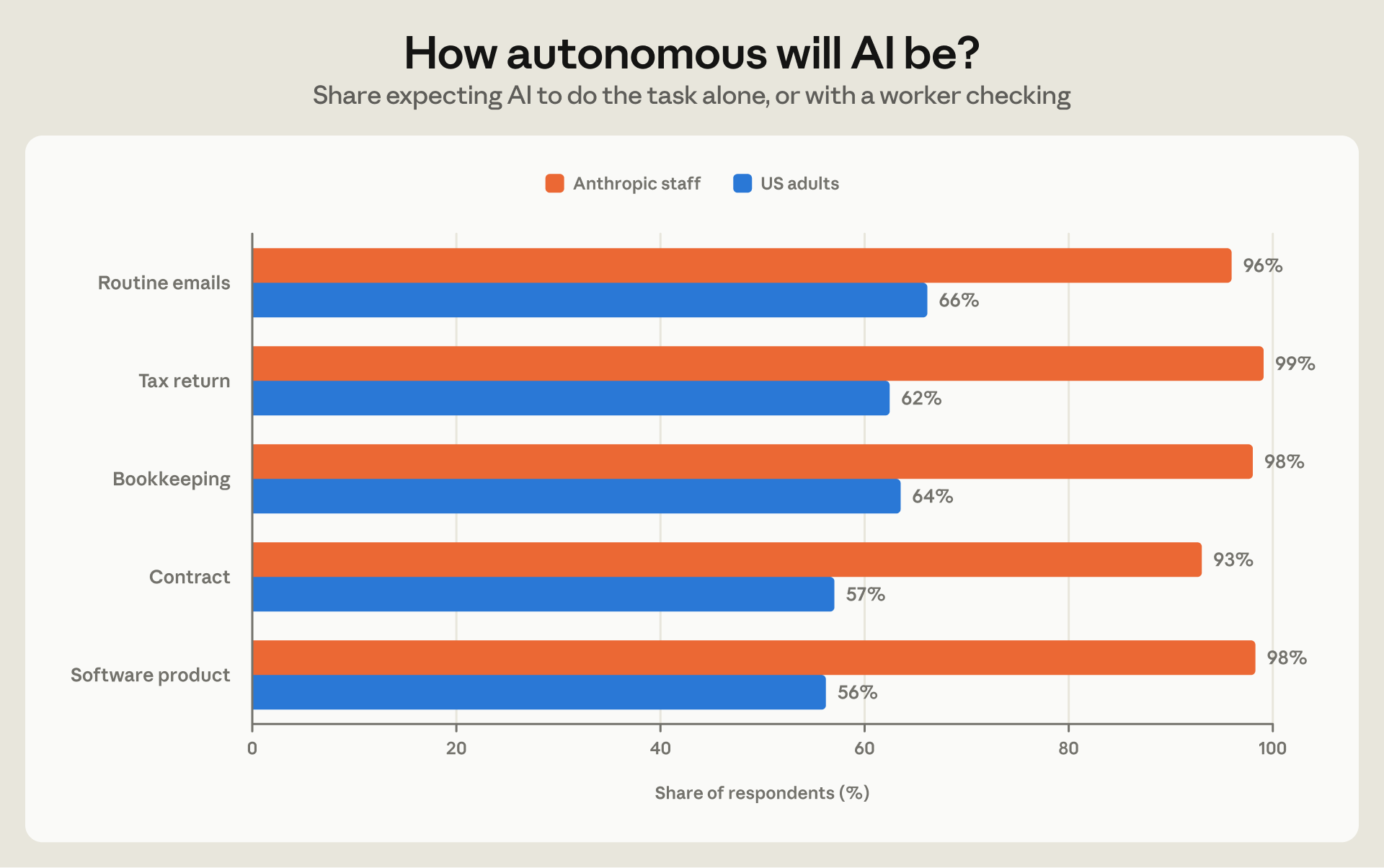
人工智能对劳动力市场的影响,在一定程度上取决于人工智能是自主完成复杂任务,还是与人类协作完成。前者往往会取代人类劳动者。反之,当人工智能增强人类的能力时,劳动者的效率会提高。为了了解 Anthropic 员工和公众对 2030 年自动化与能力增强的预期,我们询问了他们:到 2030 年,人工智能和人类将如何共同完成从起草电子邮件到签订法律合同等各种任务。在 Anthropic,绝大多数员工表示,到 2030 年,人工智能要么会独自完成任务,要么会由员工评估其工作成果(图 3)。相比之下,有十分之四的美国成年人预计,人类会自己完成大部分工作,或在人工智能的协助下完成。The impact of AI on the labor market will in part depend on whether AI completes complex tasks autonomously or in collaboration with a human. The former tends to displace human workers. Alternatively, when AI complements human capabilities, workers become more productive. To get a sense for anticipated automation versus augmentation in 2030 among Anthropic staff and the general public, we asked how AI and humans will work together on various tasks ranging from email drafting to legal contracting by 2030. At Anthropic, the vast majority of staff say that by 2030 AI will either complete tasks alone or with a worker evaluating the work (Figure 3). By contrast, 4 in 10 US adults instead expect that humans will do most of the work themselves or with some AI help.
节省时间Time savings
人工智能能在多大程度上提高产出,不仅取决于它能完成哪些任务、应用范围有多广,还取决于它完成这些任务的速度有多快、效果有多好。仅仅好到足以替代工人的技术——Acemoglu 和 Restrepo(2019)称之为“差强人意”的技术——会取代劳动,却不会显著提高 GDP。相比之下,能够以极低成本或极短时间完成任务的技术,则能切实提高 GDP。How much AI raises output depends not only on which tasks it can do and how widely it is used, but also on how much faster and better it does them. A technology that is just good enough to replace workers—what Acemoglu and Restrepo (2019) call a "so-so" technology—displaces work without much increase in GDP. By contrast, a technology that completes tasks at a small fraction of cost or in a fraction of time can meaningfully raise GDP.
为了衡量人们对 AI 提升生产力的看法,我们询问了公众和 Anthropic 员工:对于一项非常适合由 AI 完成的任务,使用 AI 完成需要多长时间,与不使用 AI 相比如何。完成一项任务所需时间减半,相当于每小时产出翻倍。3To measure perceptions about the productivity lift from AI, we asked the general public and Anthropic staff how long a task for which AI is well suited takes with AI, compared with doing it without AI. A task done in half the time corresponds to a doubling of output per hour.3
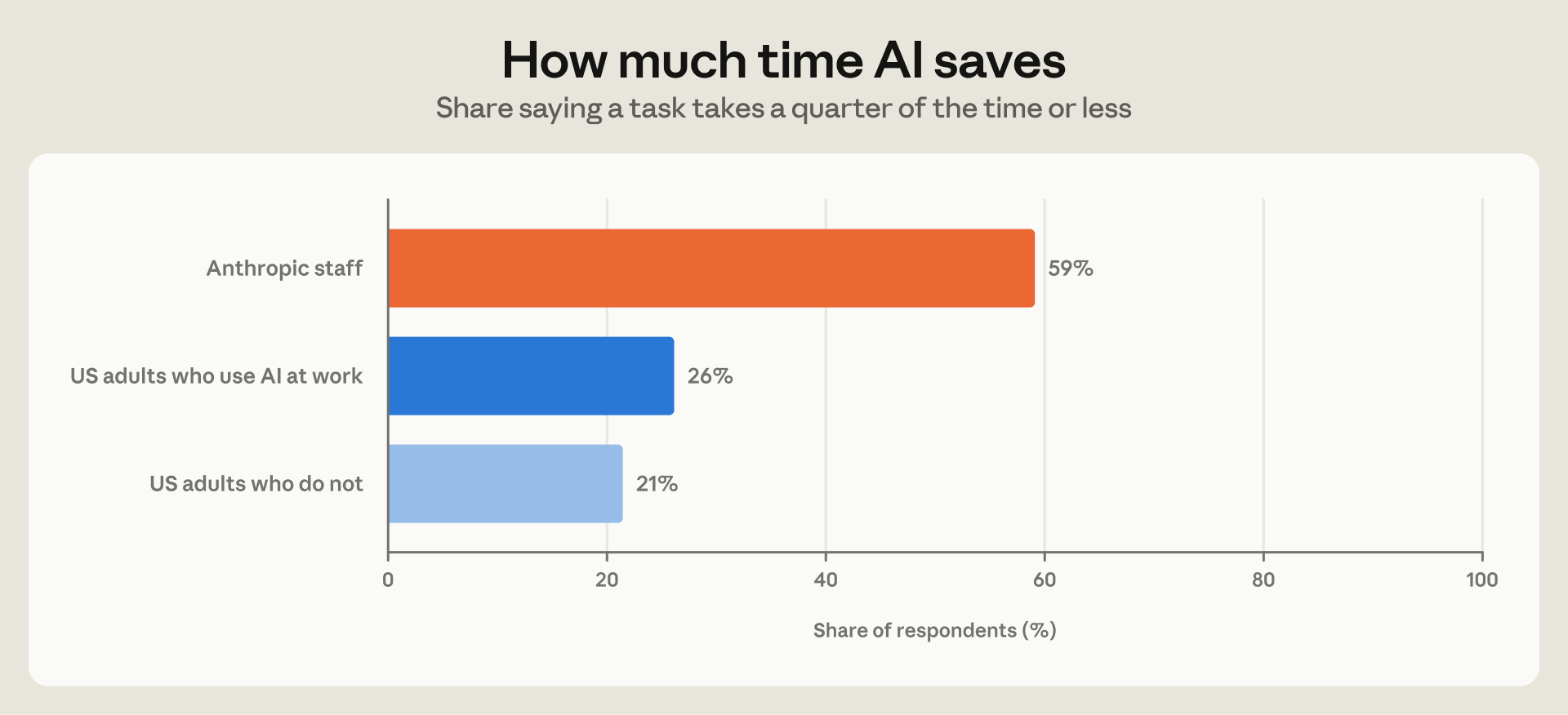
Anthropic 员工报告的预期节省时间幅度要大得多,85% 的人表示完成任务所需时间不超过原来的一半。在使用 AI 办公的美国成年人中,最常见的回答是用时减半;29% 的人表示完成任务所需时间不变或更长,而员工中只有 5% 这么说。在美国成年人中,使用 AI 办公的人有 26% 表示完成任务所需时间不超过原来的四分之一;不使用 AI 办公的人中,21% 也这么说。员工中的这一比例为 59%(图 4)。Anthropic staff report much larger expected savings, with 85% saying that it takes half the time or less. Among US adults who use AI at work, the typical answer is half the time, and 29% say the task takes just as long or longer, while only 5% of staff say so. Among US adults, 26% of those who use AI at work say a task takes a quarter of the time or less, and 21% of those who do not use AI at work say the same. For staff, that share is 59% (Figure 4).
员工可能是在描述他们的工作体验。正如《Anthropic 的就业方式正在发生怎样的变化》一文中进一步讨论的那样,Anthropic 员工在采用智能体工具后,某些方面的生产力有所提高:工程师在采用编码智能体后的一个月内新增的代码行数增至原来的三倍;销售代表在采用 AI 智能体后,与客户达成的交易也更多了。法律和招聘等其他业务职能的人均产出也有所提高。Staff may be describing what they experience at work. As discussed further in How Employment is Changing at Anthropic, Anthropic employees increased productivity on some dimensions after adopting agentic tools: the lines of code engineers added tripled in the month after adopting coding agents and sales representatives closed more deals with clients after adopting AI agents. Output per person also rose in other business functions, like legal and recruiting.
自己的工作与职位Own work and jobs
AI 能够完成他们自己工作的多少部分How much of their own work AI will be able to do
或许并不令人意外的是,谈到人工智能对各自工作的影响时,公众与 Anthropic 员工之间的看法存在很大差异(图 5)。Anthropic 员工平均认为,到 2030 年,人工智能能够完成他们目前 75% 的工作时长。美国劳动者(即表示自己有工作的受访者)平均认为这一比例为 28%;只有二十分之一的人认为,到 2030 年,人工智能能够完成他们 80% 或以上的工作时长。Perhaps unsurprisingly, we find a large gap in perceptions between the general public and Anthropic staff when it comes to AI’s impact on their own jobs (Figure 5). On average, Anthropic staff members say AI will be able to do 75% of their current work hours by 2030. US workers (respondents who report having a job) put the share at 28% on average, and only 1 in 20 say that AI could do 80% or more of their work hours by 2030.
在美国劳动者中,人们对 AI 的预期因职业而异:从事手工行业、生产和运输工作的劳动者预计,AI 能够完成其 25% 的工时;从事计算机、工程和科学相关职业的劳动者则预计为 33%。在后一类人群中,经常使用 AI 的人预计这一比例仅为 40%;这一看法更接近美国劳动者的平均水平,而非 Anthropic 员工的平均水平(75%)。Across US workers, expectations vary by occupation: AI is expected to be able to do 25% of work hours among manual trades, production and transport workers and 33% for workers in computer, engineering and science occupations. For this latter group, those who use AI regularly expect only 40%, a belief that is closer to the average US worker than to the average Anthropic staff member (75%).
自身职业暴露度与失业预测Own-job exposure and unemployment forecasts
人们预期 AI 能完成多少自己的工作,很大程度上有助于解释他们对劳动力市场的预期。我们告知受访者,目前的失业率约为 4.2%,并请他们预测 2030 年的失业率。图 6 按受访者预期到 2030 年 AI 能够完成其本人工作时数的比例对其分组,并展示了各组的平均失业率预测。How much of their own work people expect AI to do goes a long way toward explaining what they expect for the labor market. We told respondents that the current unemployment rate was about 4.2% and asked them to forecast the rate in 2030. Figure 6 groups respondents by the share of their own hours they expect AI to be able to do by 2030, and shows each group's average unemployment rate forecast.
预计 AI 能完成不到一半工作的美国劳动者,预测失业率为 7% 至 8%。如果预计 AI 能完成一半以上的工作,预测失业率会随着受 AI 影响的工作占比上升而增加。预计 AI 能完成其工作 80% 或以上的劳动者,平均预计 2030 年的失业率将达到 12.2%,高于全球金融危机期间的峰值。在美国劳动者中,受影响的工作占比每增加 10 个百分点,预测失业率就会高出 0.4 个百分点。这并非由对 AI 的普遍乐观情绪所致。在自身工作受 AI 影响程度不变的情况下,劳动者预计 AI 能掌握的八项任务中有多少项,与其失业率预测无关。US workers who expect AI to be able to do less than half of their work forecast unemployment of 7 to 8%. Above half, the forecast increases with the share of AI-exposed work. Those who expect AI to do 80% or more of their work expect, on average, an unemployment rate of 12.2% in 2030, above its peak during the Great Financial Crisis. Across US workers, ten more percentage points of work affected is associated with 0.4 points more forecasted unemployment. General optimism about AI does not explain this. Holding their own work exposure fixed, the share of the eight tasks a worker expects AI to master is unrelated to the forecast.
尽管 Anthropic 员工自我报告的 AI 影响程度高得多,但他们之中也呈现出同样的梯度,其预测与普通民众的预测十分相似。因此,这两个群体似乎并没有对 AI 如何同时影响自身工作和更广泛的劳动力市场持有不同的看法。他们对 AI 能力的体验不同,因此预期也不同。Even though their own reported exposure is much higher, the same gradient appears among Anthropic staff, with forecasts closely mirroring those of the general population. Therefore, these two groups do not seem to hold different theories of how AI will simultaneously affect their own jobs and the broader labor market. They have different experiences of what AI capabilities are and, in turn, expectations.
招聘与再雇用Hiring and re-employment
尽管 Anthropic 的员工预计 AI 能够完成他们大部分工作,但他们也预计 Anthropic 会继续招聘。95% 的 Anthropic 员工预计未来 12 个月员工人数会增加;员工预期增幅的中位数为 66%,另有 27% 的员工预计人数至少会翻一番。这些是员工在一项内部民调中的个人预期,并不代表 Anthropic 的计划或其对员工人数的看法。即便如此,这些结果表明,自动化任务和裁减岗位是两种不同的预测,至少在一家前沿 AI 实验室是如此。Even though Anthropic staff expect AI to be able to do most of their work, they also expect Anthropic to keep hiring. 95% of Anthropic staff expect headcount to grow over the next 12 months, the median staff member expects it to grow by 66%, and 27% expect it at least to double. These are the personal expectations of staff members in an internal poll and do not represent Anthropic's plans or its view of its headcount. Even so, they show that automating tasks and shedding jobs are different forecasts, at least at a frontier AI lab.
不过,与美国成年人相比,Anthropic 员工对被 AI 取代的劳动者能多快找到新工作略显悲观。我们询问了这样一个问题:到 2030 年,一名因 AI 自动化而失去工作、且需要转行的人,要多久才能找到新工作?⁴ Anthropic 员工的回答中位数是,被 AI 取代的劳动者需要 12 个月才能在新职业领域找到一份工作。相比之下,美国成年人的回答中位数在 7 至 12 个月之间。Anthropic staff, however, are slightly more pessimistic than US adults about how quickly workers displaced by AI can find new work. We asked how long it would take a person who loses their job to AI automation in 2030—and who needs to switch occupations—to find a new one.4 The median Anthropic staff member expects that a worker displaced by AI would take 12 months to find a role in a new occupation. This compares to the median US adult response in the range of 7-12 months.
对人工智能的预期及其经济影响
Expectations about AI and their economic implications
将调查回复映射到模型推导的经济情景中Mapping survey responses to model-implied economic scenarios
在《变革性 AI 的经济情景》中,我们介绍了一个结构化框架,用于评估 AI 能力和扩散的不同未来路径可能如何转化为不同的经济结果。该模型能够将每位受访者在五个维度上的回答——能力、扩散、自动化、生产率和劳动力转型摩擦——转化为模型推算的经济结果。⁵ 在美国成年人样本和 Anthropic 员工样本中,我们筛选出回答了所有关键模型输入相关问题的受访者(分别为 3,259 名美国成年人和 1,093 名员工)。随后,我们评估每位受访者的回答所对应的经济情景,以下重点讨论其对 2030 年 GDP 增长的影响。In Economic Scenarios for Transformative AI we introduced a structured framework for assessing how different future paths for AI capabilities and diffusion might translate into differences in economic outcomes. The model allows us to translate each respondent’s answers across five dimensions — capabilities, diffusion, automation, productivity, and worker transition frictions — into model-implied economic outcomes.5 Across both our US adult and Anthropic staff samples, we identify every respondent who answered all questions related to the key model inputs (3,259 US adults and 1,093 staff). We then evaluate the economic scenario implied by those answers for each respondent, focusing below on implications for GDP growth in 2030.
根据该模型,美国成年人的回答中位数意味着2030年GDP增长率为5.4%。工作人员回答的中位数则意味着,到2030年,GDP增长率将加速至17.1%。每个群体内部的差异都很大,因此两组分布有很大重叠(图7)。附录中的图A1展示了各项信念对这一差距的贡献程度。The median US adult's answers imply GDP growth of 5.4% in 2030, according to the model. The median staff member's answers imply GDP growth accelerating to 17.1% by 2030. There is significant variation within each group, so the distributions overlap widely (Figure 7). Figure A1 in the appendix shows how much each belief contributes to this gap.
在线情景探索测验的回答Responses from online scenario explorer quiz
图 7 还展示了网站访客在一个基于该经济模型的交互式情景探索工具中输入内容所隐含的经济情景。该工具于 2026 年 9 月 9 日发布在 www.anthropic.com/institute/econ-scenarios。Figure 7 also shows the economic scenarios implied by inputs provided by site visitors to an interactive scenario explorer based on this economic model that was published at www.anthropic.com/institute/econ-scenarios on September 9, 2026.
互动式探索工具提出了我们在 2026 年 8 月向美国成年人和 Anthropic 员工调查时所用问题的简短版本。发布后的前 48 小时内,共有 23,075 名访客完成了调查,他们来自全球 140 多个国家。这些访客主动访问 Anthropic 网站上的页面并参加测验,因此他们可能比普通公众更关注 AI。事实上,他们的回答介于美国成年人和 Anthropic 员工的回答之间:访客回答的中位数意味着 12.5% 的增长。The interactive explorer asked shorter form versions of the questions we fielded to US adults and Anthropic staff in August 2026. 23,075 visitors completed the survey in the first 48 hours after publication, connecting from more than 140 countries worldwide. These visitors chose to come to a page on Anthropic's website and to take the quiz, so they are likely to be more interested in AI than the general public. Indeed, their answers place them between those of US adults and Anthropic staff: the median visitor's answers imply 12.5% growth.
在实验室里Inside the lab
员工对 AI 能力更乐观的一个原因,可能是他们对开发过程有更深入的了解。Anthropic 研究所最近发布了一份报告,探讨递归自我改进(RSI)方面的进展。递归自我改进是指 AI 系统不断提升自身能力的过程(Favaro 和 Clark,2026)。One reason staff are more optimistic about AI capabilities may be that they have greater visibility into the development process. The Anthropic Institute recently published a report on progress toward recursive self-improvement (RSI), a process where AI systems increasingly improve their own capabilities (Favaro and Clark, 2026).
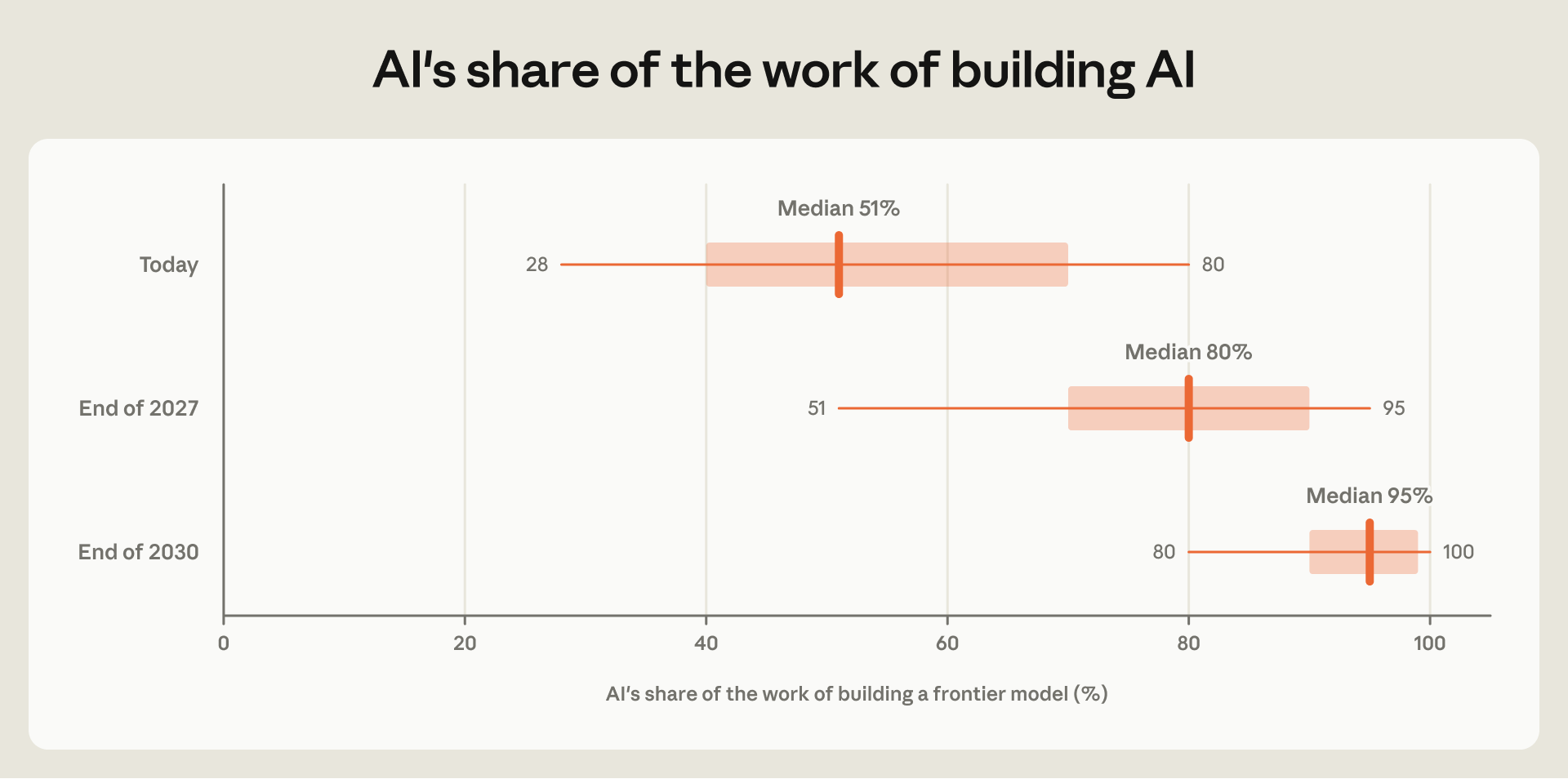
为了了解员工自身是否预期这种情况会发生,我们询问了 Anthropic 员工:如今构建一款 2026 年初的前沿模型,有多少工作由 AI 完成;他们预计未来这一比例会达到多少(图 8)。⁶ 在接受调查的 Anthropic 员工中,今天的答案中位数为 51%,预计到 2027 年底将达到 80%,到 2030 年底则达到 95%。To shed light on whether staff themselves expect this to happen, we asked Anthropic staff what share of the work of building an early-2026 frontier model is done by AI today, and what they expect it to be in the future (Figure 8).6 Among surveyed Anthropic staff, the median answer today is 51%, 80% by the end of 2027 and 95% by the end of 2030.
各团队内部对 AI 在 AI 开发中承担的工作占比的估计,差异远大于团队之间的差异。不过,研究团队的员工最接近模型构建工作,他们认为如今 AI 承担的工作占比略高:平均为 60%,而其他所有受访者为 53%。这与信息发挥了一定作用的说法相符,不过研究人员也可能因为工作性质使然,在自己的工作中比其他员工更多地使用 AI。Estimates of the share of work that AI does in AI development vary far more within teams than between them. Still, staff on research teams, who are closest to the work of building models, put AI's share today somewhat higher: 60% on average, against 53% for all other survey respondents. This is consistent with information playing some role, although researchers—by virtue of the nature of their work—may also use AI more in their own work than other employees.
与招聘预测一样,这些回答反映的是 Anthropic 员工在 2026 年 8 月参与内部民调时表达的个人观点。As with the hiring forecasts, these responses are the personal views of staff members in an internal poll fielded to Anthropic staff in August 2026.
结论Conclusion
美国成年人和 Anthropic 员工在 AI 目前能做什么方面基本看法一致。然而,他们对 AI 的进步速度、应用范围,以及以节省时间衡量的生产力提升幅度意见不一。透过《变革性 AI 的经济情景》中的模型来看,美国成年人的回答中位数意味着一种情景:美国经济的增长速度将超过其通常水平的两倍。在 AI 开发和应用前沿工作的 Anthropic 员工,则预期 AI 的进步、普及和知识工作自动化将给经济带来变革性且史无前例的改变:到 2030 年,GDP 大约每四年半就会翻一番。US adults and Anthropic staff largely agree about what AI can do today. However, they disagree about how quickly it will improve, how widely it will be used, and how large the productivity gains measured by time saved will be. Through the lens of the model in Economic Scenarios for Transformative AI, the median US adult's answers imply a scenario in which the US economy grows at more than twice its typical rate. Among Anthropic staff working at the frontier of AI development and usage, expectations about AI progress, adoption, and automation of knowledge work imply a transformative and historically unprecedented change to the economy: by 2030, GDP is doubling in size roughly every four and a half years.
那些预计未来几年人工智能将承担更多自身工作的人,也预计失业率会更高。在美国普通公众和 Anthropic 员工中都是如此;平均而言,Anthropic 员工预计自身工作将更快实现自动化,进而预计失业率会更高。我们发现,Anthropic 员工与普通公众对未来几年自身工作将有多少被自动化的看法不同,这与双方在预期上的分歧密切相关。Those who expect AI to do more of their own work in the years ahead expect higher unemployment as well. This is true for the general public in the US and among Anthropic employees; on average, Anthropic staff expect faster automation of their own work and, in turn, higher unemployment. We find that this disagreement in expectations is closely tied to differing views between Anthropic staff and the general public about how much of their own work will be automated in the years ahead.
两组人在日常工作中使用 AI 的体验大不相同。大多数 Anthropic 员工已经在工作中与 AI 协作,而 AI 承担了他们工作中的很大一部分;相比之下,只有少数美国劳动者如此。那些已经使用 AI 的劳动者,其预期与 Anthropic 员工更为接近,这表明随着 AI 的使用日益普及,公众的预期可能会发生变化。预期会变化到何种程度,取决于 AI 是否会像在前沿实验室那样,在其他地方也承担同样多的工作。The day-to-day experience with AI varies widely between the two groups. Most Anthropic staff already work alongside AI that does much of their job, whereas few US workers do. Those who do already hold expectations closer to those of Anthropic staff, which suggests that public expectations may shift as AI use spreads. How far they shift will depend on whether AI comes to do as much of the work elsewhere as it does at a frontier lab.
建议引用方式Suggested citation
@techreport{sacher2026expectations,
	author = {Sacher, Szymon and Cotter, Tess and Jones, Charles I. and Korinek, Anton and McCrory, Peter},
	title = {The {AI} Expectations Gap: Public and Frontier Lab Views on {AI}'s Impact on Work},
	institution = {The Anthropic Institute},
	type = {Technical Report},
	year = {2026},
	month = oct,
	url = {https://www.anthropic.com/research/ai-expectations-gap}
}致谢Acknowledgments
斯科特·布斯、梅雷迪思·卡兰、叶娜·赵、亚当·法里纳、本·福勒、瑞安·赫勒、艾斯琳·基南、伊娃·柳比奇、马克西姆·马森科夫、马特·莫恩(Morning Consult)、马特·芒迪(Morning Consult)、凯丽·珀森、莎拉·波拉克、桑蒂·鲁伊斯、莫妮卡·图霍夫斯卡、希瑟·惠特尼、内森·威尔默斯、金·怀西、查尔斯·杨、杰克·克拉克、达里奥·阿莫代伊Scott Booth, Meredith Callan, Yena Cho, Adam Farina, Ben Fowler, Ryan Heller, Aisling Keenan, Eva Lyubich, Maxim Massenkoff, Matt Mohn (Morning Consult), Matt Monday (Morning Consult), Kerry Persen, Sarah Pollack, Santi Ruiz, Monika Tuchowska, Heather Whitney, Nathan Wilmers, Kim Withee, Charles Yang, Jack Clark, Dario Amodei
参考资料References
Acemoglu, D. 和 P. Restrepo(2019)。“自动化与新任务:技术如何取代并重新吸纳劳动力。”《经济展望杂志》33(2),3–30。Acemoglu, D. and P. Restrepo (2019). "Automation and New Tasks: How Technology Displaces and Reinstates Labor." Journal of Economic Perspectives 33(2), 3–30.
Favaro, M. and J. Clark (2026). “When AI Builds Itself.” The Anthropic Institute. https://www.anthropic.com/institute/recursive-self-improvement.
Korinek、A.、C. I. Jones、S. Sacher、T. Cotter 和 P. McCrory(2026)。《变革性人工智能的经济情景》。Anthropic 研究所工作论文第 2026-02 号。Korinek, A., C. I. Jones, S. Sacher, T. Cotter and P. McCrory (2026). "Economic Scenarios for Transformative AI." The Anthropic Institute Working Paper No. 2026-02.
Massenkoff, M., E. Lyubich, S. Sacher, Z. Hitzig, S. Zhang, R. Heller and P. McCrory (2026). “Anthropic Economic Index report: Cadences.” The Anthropic Institute. https://www.anthropic.com/research/economic-index-june-2026-report.
Wilmers, N., R. Catipon, M. Massenkoff and P. McCrory (2026). “How Employment is Changing at Anthropic.” The Anthropic Institute. https://www.anthropic.com/research/employment-at-anthropic.
附录Appendix
此处可用。Available here.
脚注Footnotes
- Morning Consult 于 8 月 11 日至 23 日对美国成年人开展了这项调查,共有 10,980 名美国成年人参与。调查结果经过加权,以代表成年人口。关于未来的问题,一半受访者被问及 2027 年的情况,另一半则被问及 2030 年的情况。除非另有说明,我们报告的是关于 2030 年的回答。调查通过在线方式向主动报名的受访者开展,因此未涵盖无法上网的成年人;而且受访者可能在某些方面与总体人口存在差异,仅通过人口统计学特征加权无法消除这些差异。员工调查是一项内部民意调查,于 8 月 9 日至 12 日开展,共有来自公司各部门的 1,334 人参与。调查结果未经加权,所有人都被问及 2030 年的情况。Morning Consult fielded the survey of US adults between August 11 and 23 and reached 10,980 US adults. Its responses are weighted to be representative of the adult population. Questions about the future were asked about 2027 for one half of respondents and about 2030 for the other half. We report the 2030 responses unless we say otherwise. The survey was administered online to opt-in panelists, so it excludes adults without internet access and may differ from the population in ways weighting on demographics cannot correct. The staff survey was an internal poll that ran from August 9 to 12 and drew 1,334 respondents from every part of the company. It is unweighted, and everyone was asked about 2030.
- Morning Consult 于 9 月 17 日至 24 日再次提出了相同的问题,并在最后新增了两个问题,共调查了 7,613 名美国成年人。主要结果变化不大:这份样本中美国成年人的答案中位数意味着,到 2030 年 GDP 将增长 5.6%,失业率为 4.7%。变化最大的是,预计到 2030 年会有一项诺贝尔奖级别发现的美国成年人比例升至 44%,高于此前的 39%。本文全篇报告的均为 8 月份的结果。Morning Consult fielded the same questions again between September 17 and 24, with two new questions added at the end, and reached 7,613 US adults. The main results changed little: the median US adult's answers in this sample imply GDP growth of 5.6% and unemployment of 4.7% in 2030. The largest change was a rise in the share of US adults expecting a Nobel-level discovery by 2030 to 44%, up from 39%. We report the August results throughout.
- 这类似于我们在 Anthropic 经济指数中使用的分类器,用于评估人们和企业交给 Claude 处理的任务所节省的时间。例如,请参阅《根据 Claude 对话估算 AI 带来的生产力提升》。This is analogous to the classifier we use in the Anthropic Economic Index to assess time savings among the tasks that people and businesses bring to Claude. See, for example, Estimating AI productivity gains from Claude conversations.
- 我们向两组人提出了以下问题:在正常时期,失业者通常需要大约 3 个月才能找到新工作。现在想想,一个人在 2030 年因 AI 自动化而失业,需要转行从事不同的职业。你觉得他需要多久才能找到新工作?面向普通公众的选项从“不到 1 个月”到“超过 3 年,或者永远也找不到新工作”。Anthropic 的员工则通过滑块以月为单位作答。Both groups were asked the following: In normal times, someone who loses a job typically takes about 3 months to find a new one. Now think about a person who loses their job in 2030 due to AI automation and needs to switch into a different occupation. How long do you think it would take them to find a new job?. For the general public the answer options ranged from "less than 1 month" to "more than 3 years, or would never find a new job”. Anthropic staff answered in months on a slider.
- 我们按照《变革性 AI 的经济情景》中概述的程序,将原始调查答案映射为模型关键输入变量所隐含的路径。详见该文附录 B。在本次分析中,模型中的其他所有参数均保持为“显著”情景中的取值。We follow the procedure outlined in Economic Scenarios for Transformative AI for mapping raw survey answers into implied paths for key inputs into the model. See Appendix B therein. For this exercise, we hold all other parameters in the model at their values in the “Substantial” scenario.
- 每项结果分别计算中位数,因此增长率的中位数和失业率的中位数可能并非来自同一位受访者。
- 这是一个比 AI 编写了多少代码更广泛的问题。Favaro 和 Clark(2026)报告称,如今合并到 Anthropic 代码库中的代码有 80% 以上由 Claude 编写,但构建前沿模型还涉及研究方向、实验设计与评估等诸多方面。This is a broader question than how much code AI writes. Favaro and Clark (2026) report that more than 80% of the code merged into Anthropic's codebase is now written by Claude, but building a frontier model also involves research direction, experiment design and evaluation and more.
相关内容Related content
使用 Claude 设计更高效的量子电路Designing more efficient quantum circuits with Claude
我们向 Claude 提供了八种量子电路的通俗语言规格说明,以及一个用于检查和评估其设计的自动化评估器。Claude 基本上独立完成了工作,设计出的电路性能超过了此前发表的最佳电路,有些甚至提升了一个数量级或更多,这可能意味着实用型量子计算机将比此前预期更快成为现实。We gave Claude plain-language specifications for eight quantum circuits, along with an automated evaluator to check and score its designs. Working largely on its own, Claude improved on the best published circuits, in some cases by an order of magnitude or more, which could bring practical quantum computers closer than previously anticipated.
Read moreClaude 揭示 ECDSA 曲线的起源Claude reveals ECDSA curve origins
一个广受欢迎的加密标准,其起源之谜困扰人们数十年,如今终于得到了解释。The decades-old mystery of the origins of one of the most popular cryptographic standards has been explained.
Read moreAnthropic 的就业状况正在发生怎样的变化How employment is changing at Anthropic
AI 如何重塑了 Anthropic 的工作与就业?作为一家处于 AI 应用前沿的公司,Anthropic 可能预示着 AI 将如何改变整个经济中的工作组织方式、招聘和劳动力需求。How has AI restructured work and employment at Anthropic? As a company at the frontier of AI adoption, Anthropic could be a leading indicator of how AI will shift work organization, hiring, and labor demand across the economy.
Read more